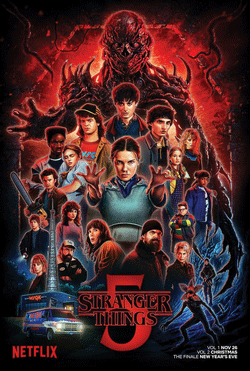
The decade-long, mammoth of a show, “Stranger Things,” arguably the show of this generation, wrapped up a little while ago with a whopping 2 hour 8 minute finale–but did it stick the landing? Between an expanded cast size, expanded budget, expanded run time, and expanded sets, it sure sets the bar for size, but that doesn’t necessarily constitute solid television–and in my opinion, “Stranger Things” Season 5 missed a couple big markers.
For starters, the cast size. As a rule, the first few seasons had eight or nine characters splitting the runtime, with about three plotlines stringing along, then coming together for the last few episodes for a big boss battle. Season four and even more Season 5 stray from this pattern, with around eighteen ‘main characters’, each fighting tooth and nail for their three minutes of screentime. This leads to a loss of continuity, and half the time, everyone is just trying to find each other and explain what they’ve discovered, leaving some characters trailing behind like stray puppies without an arc to call their own.
Now, it’s not all bad– the first half of Season 5 had its nail-biting moments (ending of episode four, anyone?) that we’ve come to expect from “Stranger Things.” A few characters even got emotionally resonant arcs–but it’s easy to forget about these moments with just how long everything is. Sitting down for an episode or two can take the time of a full length movie slot, and the plot just doesn’t push fast enough to justify how long we end up just watching characters wandering around.
Undoubtedly, it was the acting that saved this season–in particular, Gaten Matarazzo as Dustin stole the show, giving us the most emotional moments of the season. Additionally, Caleb McLaughlin, Sadie Sink, Natalia Dyer, and Charlie Heaton all kept the emotional bonds of their characters alive and well, carrying most of the emotional weight. Being long-running members of the show, their dynamics kept it grounded in reminders of past Stranger Things seasons. Even newcomer Nell Fisher brought spunky innocence and childhood back into the show now that the main group is all in their twenties.
And the show very much needed strong acting, because by the end it seemed determined to put various combinations of characters in long, one-on-one conversations right before big moments, which…sometimes hits the mark, and sometimes feels like a clip of a podcast somehow wormed its way into the show.
However, this season’s biggest downfall was the plot holes. The sheer number of them led to a popular fan theory so widespread that it crashed Netflix: Conformity Gate. The idea was that the finale was actually a fake-out, and the show was hiding a secret, ‘real’ finale. This was born from the fact that Stranger Things has always claimed that it is for the outcasts and the nerds, but then gives a cut-and-dry, quite conformist ending, rife with plot holes and missing many of the things teased in interviews. Conformity Gate hasn’t happened…yet.
A high point of the show was the music, something “Stranger Things” has consistently done well–there were several needle drops, not to spoil, that will have you on the edge of your seat.
Looking back, it was an okay season to end a great show, overburdened by its own success and the sheer amount of lore and theories it was dragging behind it as fans waited literal years for seasons to release. It resolved most characters, and everything else was neatly kicked under the bed to keep the ending neat and pretty to look at. “Stranger Things” remains worth a watch, and worth a rewatch, for its stellar acting, if nothing else.