The new school year always comes in with mixed emotions. Some may feel enthusiastic to see friends and experience new things such as clubs and activities, while others may feel anxious about fitting in and getting back into routines. This year the new school year also came with some new state laws and policies.
The state law banning phones from the educational day required a new zero tolerance policy. If a student is caught with a phone, it is immediately brought to the office and the student can pick it up at the end of the day; if they are caught twice with their phone it is brought to the office and that student receives in-school suspension. Any additional phone violations lead to out of school suspension.
Teachers have noticed the improvement in their classrooms. Senior English teacher Robert Hutton said “Engagement level has gone up and students are more engaged even with talking to other teachers and even other students they are just more engaged throughout the classroom the scores have been higher especially in analysis and presentations eye contract has gone up which has been a huge issue within seniors compared to the last couple of years I am seeing a lot of benefits in not having phones students want to do well with the removement of those phones.”
Hutton isn’t the only teacher to notice the improved student interactions. “When we have time in class to talk to a shoulder partner about this or that question they can work together and they won’t look to their shoulder partner scrolling on social media,” said physics teacher Mike Dobberstein.
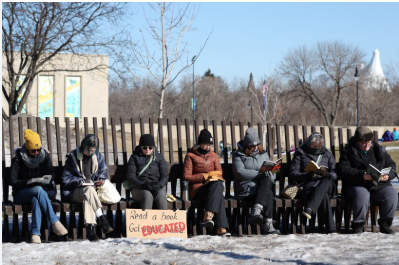
The classroom isn’t the only place changing with the lack of phones. The commons and library are different spaces as well. “The students are actually talking to each other and having conversation instead of being on their phones with each other and reading more books. Many more books are getting checked out,” said Michelle Zimprich, tech support specialist for North.
The teachers aren’t the only ones with this thought the students see it too. Senior Finn Kielty noticed “people talk more, the hallways are louder,” he said.
Less screen time can be positive for classwork too. “I spend a lot less time on my phone in general. My screen time is way down and it's made my day to day easier because I spend less time on distractions and I'm locked in on what I need to do,” said senior Berit Hillmer.
However, the current tech and its speed makes some students miss their phones. “Sometimes teachers want us to bring our computers up for something really quick but it ends up taking 5-10 minutes just cause they take a long time to load,” said junior Henry McMullen-Wendt.
What was wrong with the previous policies in place last year, was it not enough? Travis Christensen principal of Fargo North said “Honestly no, one of the things we would get consistently over the past few years[…] is that phones continued to be a concern especially with teachers with distracted students not being engaged to what is happening.”
The previous phone policy required phones to be put away in backpacks or phone pouches hanging in classrooms but was enforced inconsistently before. Some teachers would enforce the policy of turning it into the office, where students could pick it up after a first offense, but parents would have to pick it up for any additional offenses, while other teachers did not address phones at all.
Last year teachers seemed to struggle with managing students' phone usage. “I did not get a masters degree to be the phone police,” said junior English teacher Tonya Hetland. “I was exhausted, it did not build rapport with students, and I felt like it put content on the back burner. So this year it has been a refreshing change that English and reading is first,” said Hetland.
Overall, most are recognizing the improved school day, with more understanding of homework. Maura McGoldrick, the science para, said “I have one student in particular who said she's monitoring her grades and keeping up with her teachers more. I think it's positive academically and it’s also positive socially because it's more face to face.”
Surprisingly, students seem to be more upset about their backpack privileges being revoked rather than their personal devices. Backpacks are required to remain in lockers for the duration of the school day. “The backpack ban was necessary for the phone ban to actually work because it removes the temptation and immediate access point,” said assistant principal Erin Sinner.
“Interestingly, as more states across the nation are implementing cell phone bans, psychologists have been inundated with real-time data and research points. Dr. Angela Duckworth's research shows that the farther a phone is physically from a student, the better their academic performance. I recently heard her on a podcast where she stated "the farther the phone, the higher the GPA," Sinner said. “If backpacks were permitted, students could easily access phones discreetly, despite the state law requiring phones to be locked and stowed away. Having students secure phones in lockers supports the science behind the law. It shifts the environment so it's not about constant monitoring, but about removing the distraction altogether.”
Despite this, many students are still upset with the change, partially because they aren't used to carrying their supplies in their arms. “I keep dropping things and you stop hallway traffic and I've seen a freshman get pushed over because they kept dropping their stuff,” said junior Olivia Desmarais.
One student said they have experienced backlash for being able to carry around a backpack. “I have actually been made fun of for having my backpack because others aren’t allowed to,” said junior Henry McMullen-Wendt.
He argues the new policy can reveal who needs special accommodations. “It’s showing which students have special needs and need simple accommodations like a backpack and I know personally that’s gotten me bullied because of it,” said McMullen-Wendt.
For others, it hasn’t really affected their day to day. Junior Tehya Gag said “It’s an inconvenience but it’s just a binder and a computer sleeve.”
Gag’s thoughts about the policy changed after some reflection. “Im less angry about it; I got past the ‘how could they possibly do this’, to, okay, I can see the practical purpose for this,” she said.
However, this policy isn’t as new as students might think. Before Covid, there were no backpacks allowed in classrooms. When students returned to school in fall 2020, to ease tracking of social distancing and ‘close-contacts,’ lockers were closed and students were permitted to carry their backpacks to each class. Now, the administration at the high school level is returning to that initial policy.
Fargo North student body and faculty are adjusting to the new policies and laws with different perspectives. Sophomore Mollie Peterson said “I have been very surprised, I have conversed with more people and have met more people and my grades are higher than they were at this time [last year].”